Physical Address
304 North Cardinal St.
Dorchester Center, MA 02124
Physical Address
304 North Cardinal St.
Dorchester Center, MA 02124

Nourish Better, Live Fuller
Nourish Better, Live Fuller

If you searched for “diet full form,” you probably weren’t thinking about food at all. In India, DIET stands for District Institute of Education and Training, and it has nothing to do with dieting or nutrition.
This confusion is common. The word “diet” instantly brings up images of weight loss and meal plans. But in the world of Indian education, DIET is a government institution that trains school teachers, shapes curriculum, and strengthens learning at the grassroots level.
This article breaks down everything you need to know about DIET — its full form, history, objectives, courses, functions, and why it matters for students, teachers, and job seekers across India. By the end, you’ll understand exactly what DIET does and how it fits into the bigger picture of Indian education.
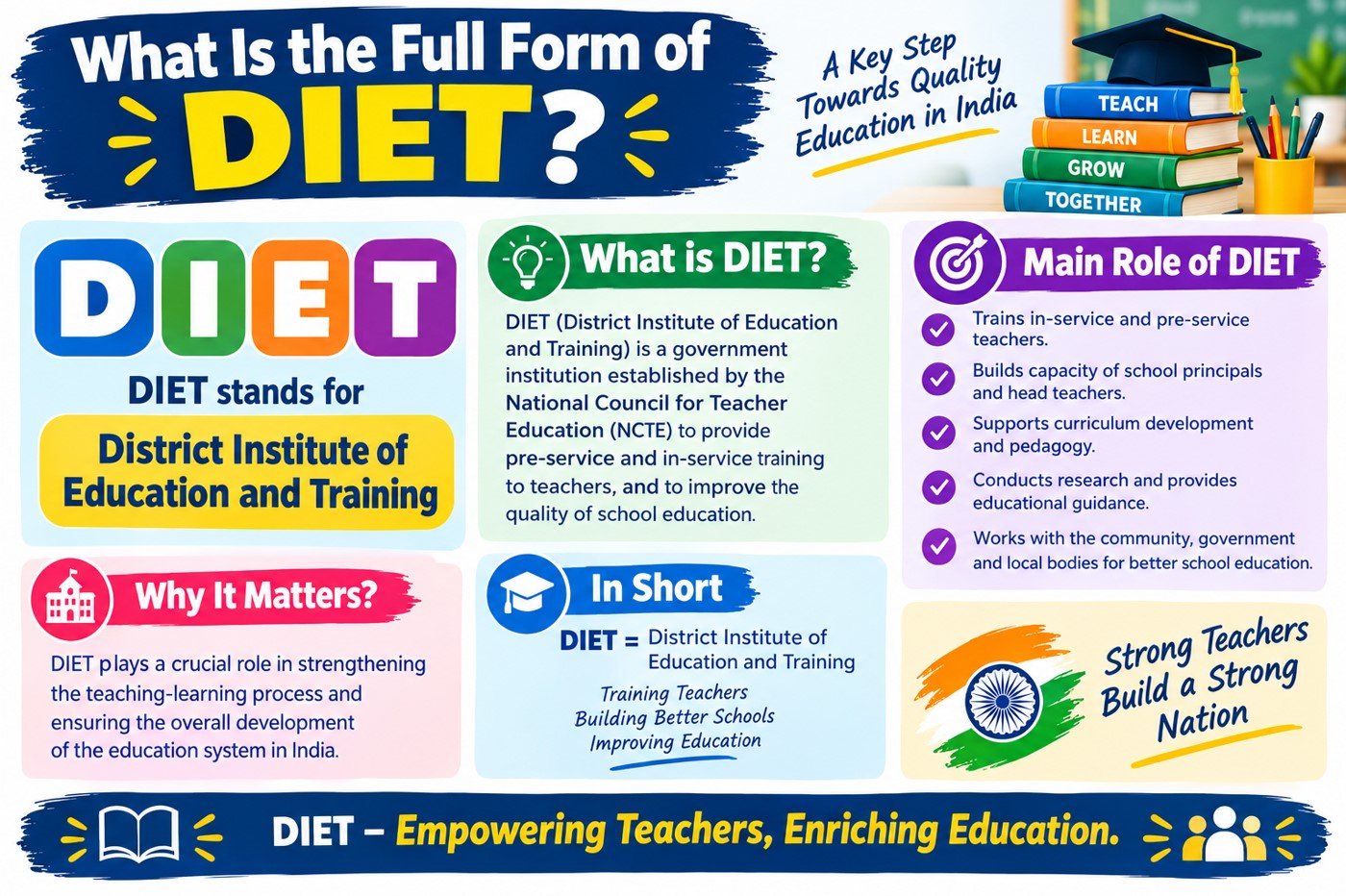
The full form of DIET is District Institute of Education and Training.
It is a government-run academic institution established in almost every district of India. Its core purpose is to train teachers, especially those working at the elementary and primary school level, and to support the overall quality of school education within that district.
Each state has its own network of DIETs, and they operate under the guidance of the State Council of Educational Research and Training (SCERT), which itself works under the framework set by the National Council of Educational Research and Training (NCERT).
In short, DIET is the district-level academic authority responsible for teacher education, curriculum support, and educational research within its jurisdiction.

This mix-up happens for a simple reason: the English word “diet” already has a well-known meaning related to food, nutrition, and weight management. When someone searches “diet full form,” search engines and readers often expect a nutrition-related answer.
However, DIET written in capital letters is an acronym, not the everyday English word. Acronyms often overlap with regular words, and this is one of those cases. Once you know the context — Indian education — the meaning becomes clear.
Here’s a quick comparison to avoid confusion:
| Term | Meaning | Context |
| diet | Food and nutrition habits | Health, wellness, fitness |
| DIET | District Institute of Education and Training | Indian school education system |
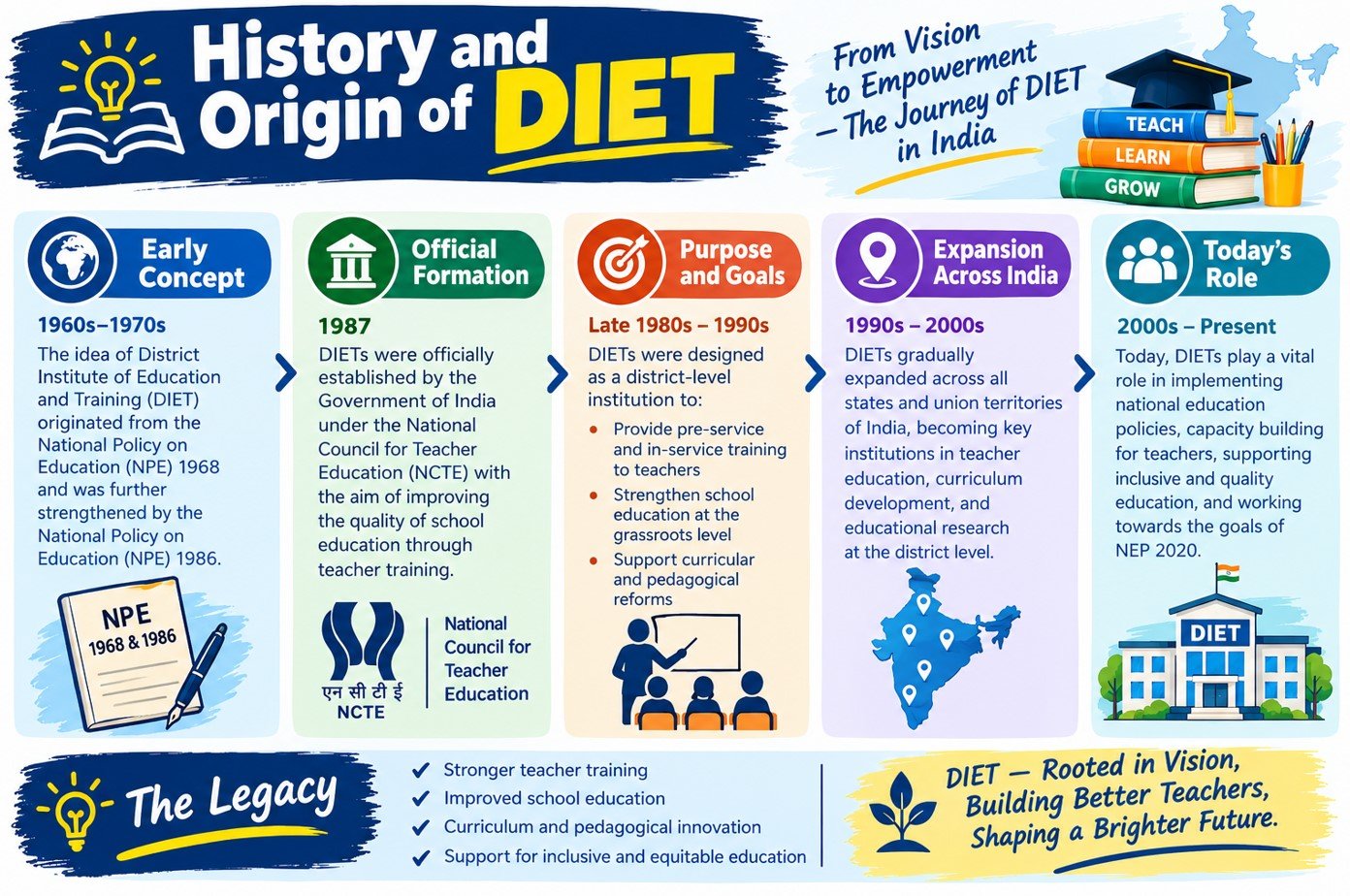
DIET was not created overnight. Its roots go back to the National Policy on Education (NPE), 1986, a landmark policy that aimed to reform and modernize education across India.
Before DIET existed, teacher training was handled mostly at the state level, which made it difficult to address local and district-specific needs. Policymakers realized that a decentralized, district-level system would work better because it could respond directly to ground-level challenges in each region.
As a result, the Government of India, through the Ministry of Human Resource Development (now called the Ministry of Education), launched a Centrally Sponsored Scheme for Restructuring and Reorganisation of Teacher Education in 1987. Setting up DIETs in every district was one of the five major components of this scheme.
By the early 1990s, DIETs had been established across most Indian states, forming a third tier of academic support — below the national (NCERT) and state (SCERT) levels, but closer to actual schools and teachers on the ground.

Every DIET is built around a few core goals. These objectives guide how the institute functions and what services it provides to teachers and schools.
These objectives make DIET a critical link in India’s education chain — connecting national policy with the day-to-day realities of teaching in villages, towns, and cities.
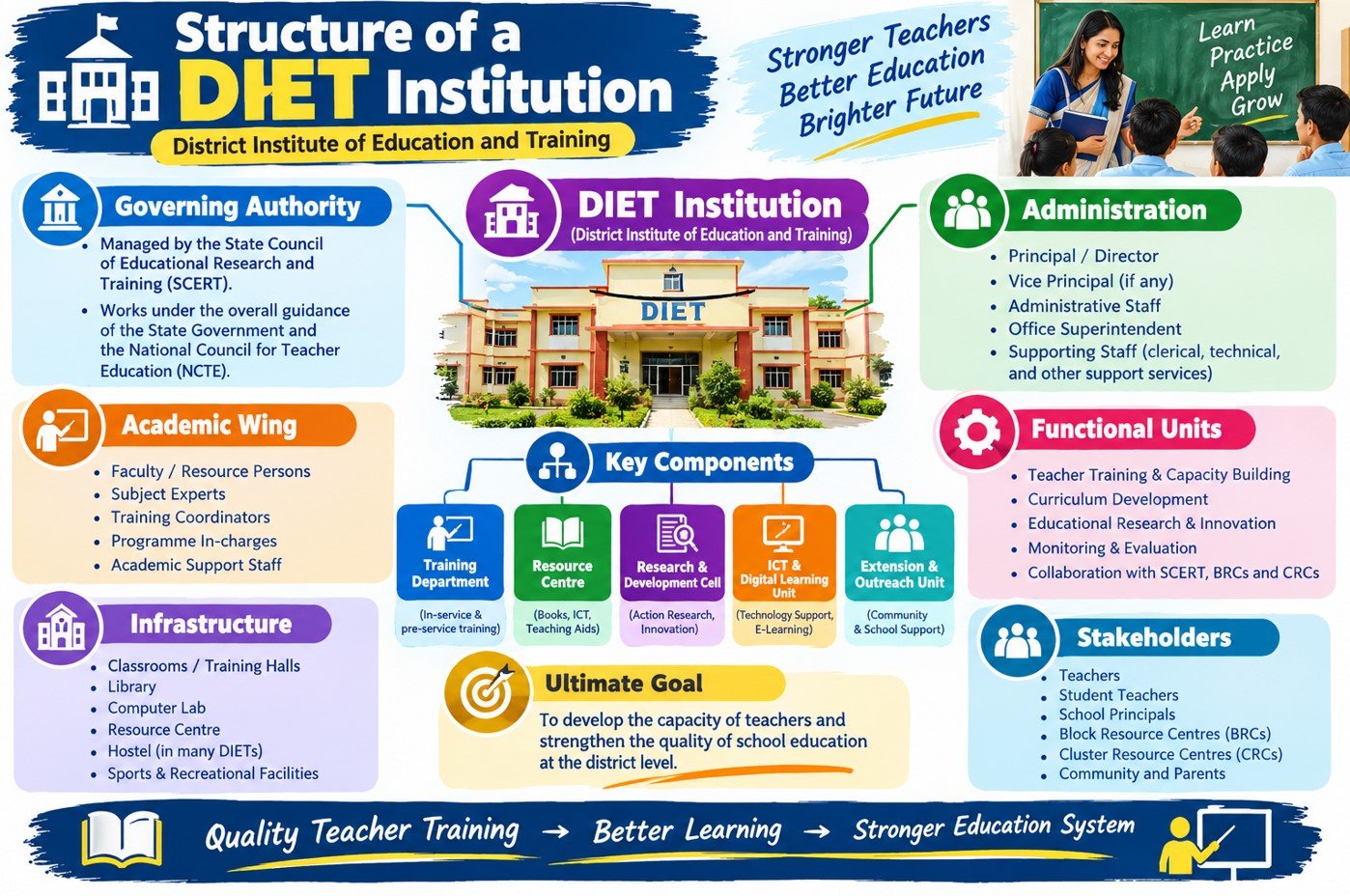
A typical DIET is organized into several academic wings, each handling a specific function. This structure allows the institute to cover teacher training, research, and community outreach simultaneously.
Each wing works together to ensure teachers receive well-rounded training, from classroom pedagogy to modern technology use.

DIET institutions are best known for offering teacher training diploma courses. These programs are especially popular among students who want to become primary or elementary school teachers.
These courses are recognized by the National Council for Teacher Education (NCTE), which means they carry official validity for teaching jobs in government schools across India.

Beyond training teachers, DIET performs several ongoing functions that keep the district’s education system running smoothly.
These functions make DIET far more than a training college — it acts as an academic support system for the entire district’s school network.
People often confuse DIET with SCERT and NCERT since all three deal with education and teacher training. Here’s how they differ:
| Feature | NCERT | SCERT | DIET |
| Full Form | National Council of Educational Research and Training | State Council of Educational Research and Training | District Institute of Education and Training |
| Level | National | State | District |
| Main Role | Sets national curriculum framework and policy | Implements policy at the state level | Trains teachers and supports schools locally |
| Reports To | Ministry of Education, Government of India | State Education Department | SCERT |
| Focus | Textbooks, national curriculum, research | State curriculum, teacher training programs | Direct teacher training and district support |
Understanding this hierarchy helps clarify why DIET exists — it’s the ground-level executor of policies designed at the national and state levels.

If you’re interested in becoming a teacher through a DIET-run course, here’s a general overview of the admission process. Note that exact steps vary slightly by state.
Since each state education department manages its own DIET admissions, it’s important to check the official website of your state’s School Education Department for exact dates and eligibility criteria.
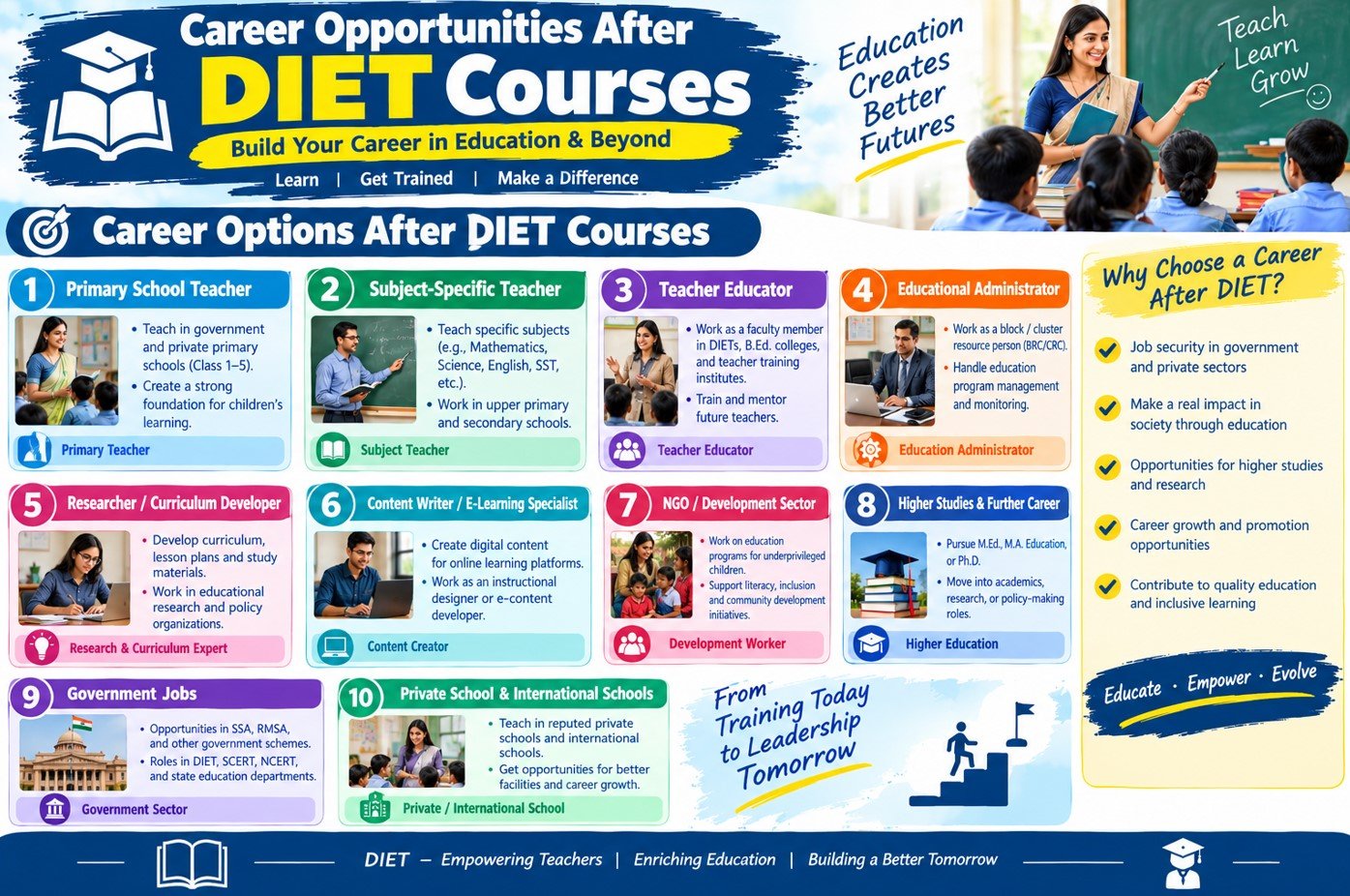
Completing a course from a DIET opens up several career paths, mainly centered around teaching and education administration.
Many state governments require candidates to clear the Teacher Eligibility Test (TET) after completing D.El.Ed or B.T.C. to qualify for government teaching positions. This makes DIET the starting point of a structured career path in Indian education.

Like any government system, DIET has strengths and areas that need improvement.

Despite its important role, DIET has faced several structural challenges since its inception.
According to education researchers, many DIETs gradually shifted away from their original mission of providing academic leadership and research support, becoming focused mainly on running diploma courses like B.Ed and D.El.Ed. The rise of Block Resource Centres (BRCs) in many states also reduced the unique role DIETs were meant to play, as some of their responsibilities overlapped with these newer bodies.
Other common challenges include:
Addressing these gaps is essential if DIETs are to fully deliver on their original vision of strengthening education from the district level up.
DIET stands for District Institute of Education and Training, a government institution focused on teacher training in India.
No. While the word “diet” commonly refers to food habits, DIET as an acronym refers to an educational institution in India, unrelated to nutrition.
Most DIETs offer D.El.Ed (Diploma in Elementary Education), and some states offer equivalent programs like B.T.C. Special education diplomas are also available at select institutes.
DIETs operate under the State Council of Educational Research and Training (SCERT), which in turn follows guidelines from NCERT at the national level.
Yes. D.El.Ed and B.T.C. courses from recognized DIETs are approved by the National Council for Teacher Education (NCTE) and are valid for teaching positions, subject to clearing the relevant Teacher Eligibility Test (TET).
DIETs were established starting in the late 1980s and early 1990s, following the National Policy on Education, 1986.
DIET works at the district level, focusing on direct teacher training, while SCERT operates at the state level, setting broader curriculum and policy direction.
Yes. Graduates can pursue B.Ed, M.Ed, or specialized education degrees to advance their teaching careers.
Admissions are handled at the state level, usually through each state’s School Education Department or a centralized online portal.
Most districts have at least one DIET, though availability and infrastructure quality can vary between states and regions.
So, the next time someone asks about “diet full form,” you’ll know it’s not about food at all — it’s about District Institute of Education and Training, a vital part of India’s teacher education system.
From training future teachers to supporting curriculum development and educational research, DIET plays a foundational role in shaping how children learn across the country’s districts. While the system faces challenges like staffing shortages and resource gaps, its purpose remains essential: bringing quality education closer to the classroom.
Whether you’re a student exploring teaching as a career, a parent curious about the education system, or simply someone who searched a confusing acronym, understanding DIET gives you a clearer picture of how India builds its teaching workforce from the ground up.


[…] understand DIET properly, it helps to know the story behind […]
[…] Learn More: DIET Full Form […]
[…] Learn More: DIET Full Form […]
[…] Click Now: DIET Full Form […]
[…] Click Here: DIET Full Form […]