Physical Address
304 North Cardinal St.
Dorchester Center, MA 02124
Physical Address
304 North Cardinal St.
Dorchester Center, MA 02124

Nourish Better, Live Fuller
Nourish Better, Live Fuller
Have you come across the term “DASH diet” while searching for ways to control blood pressure? You are not alone. Millions of people search for the DASH diet full form every month because doctors, nutritionists, and health articles keep mentioning it.
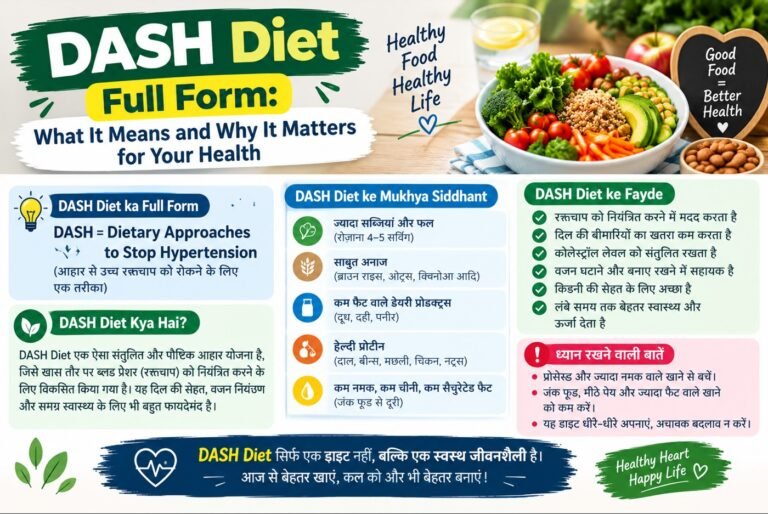
The good news is that the answer is simple. DASH stands for Dietary Approaches to Stop Hypertension. It is not a fad diet. It is a scientifically tested eating pattern that was created to help people manage high blood pressure without relying only on medicines.
In this article, you will learn what the DASH diet full form means, why it was created, how it works, what foods it includes, and how Indian readers can follow it using everyday, locally available foods. By the end, you will have a clear, practical understanding of this eating plan and whether it suits your lifestyle.

The DASH diet full form is Dietary Approaches to Stop Hypertension. Each word explains a part of its purpose:
So, in simple words, the DASH diet is an eating pattern designed to prevent and control high blood pressure using everyday food choices instead of medication alone.
Unlike many diets that focus only on weight loss, DASH focuses on overall heart health. It was developed by medical researchers, not fitness influencers, which is why doctors around the world, including cardiologists in India, often recommend it.

The DASH diet was developed in the 1990s through research funded by the National Heart, Lung, and Blood Institute (NHLBI), part of the U.S. National Institutes of Health. <cite index=”4-1″>The DASH diet originated in the 1990s as a healthy diet approach to help with blood pressure control, offering a heart-healthy, balanced way of eating that includes all food groups.</cite>
Researchers wanted to know if food alone, without medicine, could lower blood pressure. <cite index=”3-1″>The first major study, called the Dietary Approaches to Stop Hypertension (DASH) study, tested this idea on hundreds of adults with varying blood pressure levels.</cite> The results were clear: people who ate more fruits, vegetables, and low-fat dairy saw meaningful drops in their blood pressure, often within just two weeks.
Since then, the DASH diet has been studied extensively. <cite index=”2-1″>It has consistently ranked among the top diets by health experts for over a decade, largely because it is scientifically proven to lower blood pressure and reduce cardiovascular risk.</cite>
This long track record is one reason the DASH diet full form and meaning continue to be searched by people who want a trustworthy, doctor-backed eating plan.
Learn More: DIET Full Form

The DASH diet works on a simple principle: certain nutrients help control blood pressure, while others raise it.
Here is how it functions:
<cite index=”5-1″>The standard DASH diet limits sodium to 2,300 milligrams a day, which is roughly one teaspoon of table salt.</cite> A stricter version limits sodium further for people who need faster blood pressure control, though most people find the standard version easier to maintain long-term.
Unlike restrictive diets, DASH does not eliminate entire food groups. <cite index=”4-1″>It does not omit any particular food group and does not necessarily involve calorie restriction, making it easier to follow as a lifelong eating pattern rather than a temporary fix.</cite>

Understanding the nutrients behind DASH helps you make smarter food choices, even outside a strict meal plan.
Helps balance sodium levels in the body and relaxes blood vessel walls. Found in bananas, potatoes, spinach, and coconut water.
Supports healthy blood vessel function. Found in low-fat dairy, ragi (finger millet), and sesame seeds.
Helps regulate nerve and muscle function, including the muscles in blood vessel walls. Found in almonds, whole grains, and leafy greens.
Supports heart health and digestion while helping control cholesterol. Found in oats, lentils, fruits, and vegetables.
Supports muscle repair and keeps you fuller for longer, reducing unhealthy snacking. Found in lean poultry, fish, beans, and dal.
Unlike the nutrients above, sodium works against the goals of the DASH diet. Excess sodium causes the body to hold on to extra water, which increases the volume of blood in your vessels and raises pressure on artery walls. This is why reading nutrition labels and cooking with less added salt forms the foundation of the entire plan, even before you think about which fruits or grains to add.

Here is a practical breakdown of what to eat on the DASH diet, adapted for Indian kitchens.
To follow the DASH diet correctly, reduce these items:
<cite index=”6-1″>The DASH diet is low in red meat, salt, added sugars, and fat, with lean protein sources like chicken, fish, and beans preferred instead.</cite>
Here is a simple one-day plan you can adapt to your taste:
| Meal | Food Options |
| Early Morning | Warm water with lemon, soaked almonds (5–6) |
| Breakfast | Vegetable oats or moong dal chilla with mint chutney |
| Mid-Morning | One banana or a bowl of papaya |
| Lunch | Brown rice or 2 rotis, dal, sabzi, cucumber salad, low-fat curd |
| Evening Snack | Roasted chana or a handful of walnuts |
| Dinner | Grilled fish or tofu, sautéed vegetables, one roti |
| Before Bed | Warm turmeric milk (low-fat) |
This plan keeps sodium low while ensuring adequate potassium, fiber, and protein, matching the core DASH diet principles.
| Feature | DASH Diet | Keto Diet | Intermittent Fasting |
| Main Goal | Lower blood pressure | Weight loss via fat burning | Weight and metabolic control |
| Carbs | Moderate, whole grains encouraged | Very low | No restriction, timing-based |
| Sodium Focus | Strict limit | Not addressed | Not addressed |
| Sustainability | High, lifelong pattern | Moderate, hard to maintain | Moderate, depends on schedule |
| Medical Backing | Strong, NIH-developed | Growing but mixed | Growing |
| Food Restrictions | Minimal | High | Time-based, not food-based |
This comparison shows why doctors often recommend DASH over trendier diets, especially for people managing blood pressure or heart health rather than aiming for rapid weight loss.

The DASH diet offers benefits beyond just blood pressure control.
<cite index=”4-1″>Research has shown the DASH diet helps lower blood pressure, blood glucose levels, triglycerides, cholesterol, and insulin resistance, and it has also been linked to lower all-cause mortality in adults.</cite>


The DASH diet is especially useful for:
If you have kidney disease or are on blood pressure medication, consult your doctor before making major dietary changes, since nutrient needs can vary based on individual health conditions.
It is also worth noting that the DASH diet is not designed as a short-term fix. Doctors usually recommend it as a permanent lifestyle change rather than a temporary program you follow for a few weeks and then abandon. This is one reason it works better than many crash diets: the food choices feel normal enough to continue for years, not just months.
For working professionals with busy schedules, DASH is also practical because it does not require special cooking equipment or hard-to-find ingredients. Most of the recommended foods, such as dal, seasonal vegetables, curd, and whole grains, are already part of a typical Indian pantry. This makes the transition smoother compared to diets that demand imported products or expensive supplements.

Avoiding these mistakes helps you get faster, more consistent results from the DASH eating pattern.
DASH stands for Dietary Approaches to Stop Hypertension, an eating plan designed to prevent and manage high blood pressure.
Yes, many people lose weight on DASH because it emphasizes whole foods and limits added sugar, though it is primarily designed for blood pressure control rather than rapid weight loss.
The standard version allows up to 2,300 mg of sodium per day, while the lower-sodium version limits it to 1,500 mg per day for stricter blood pressure control.
Yes, DASH fits well with Indian food habits since dal, vegetables, whole grains, and low-fat dairy are already staples in most Indian households.
Many people notice a drop in blood pressure within two to four weeks of consistently following the plan.
No, it also benefits people with high cholesterol, prediabetes, or those simply wanting a heart-healthy eating pattern.
Moderate caffeine intake is generally fine, but excessive tea or coffee should be limited since caffeine can temporarily raise blood pressure.
No, DASH includes whole grains and complex carbohydrates; it is not a low-carb diet like keto.
Yes, lean protein sources like fish, skinless chicken, and egg whites are encouraged, while red and processed meats are limited.
Yes, it was developed by the National Institutes of Health and is widely recommended by cardiologists and dietitians worldwide.
The DASH diet full form, Dietary Approaches to Stop Hypertension, reflects exactly what this eating plan aims to do: help you control and prevent high blood pressure through smarter food choices. Backed by decades of research, it remains one of the most trusted, doctor-recommended eating patterns worldwide.
What makes DASH stand out is its flexibility. It does not demand exotic ingredients or extreme restrictions. Instead, it works with everyday foods like dal, vegetables, whole grains, and low-fat dairy, making it especially practical for Indian households.
If you are managing high blood pressure, have a family history of heart disease, or simply want a sustainable, heart-healthy eating style, the DASH diet offers a proven, realistic path forward. Start small, focus on reducing sodium and increasing whole foods, and let consistency do the rest.


[…] Click Here: DASH Diet Full Form […]