Physical Address
304 North Cardinal St.
Dorchester Center, MA 02124
Physical Address
304 North Cardinal St.
Dorchester Center, MA 02124

Nourish Better, Live Fuller
Nourish Better, Live Fuller

Walk into any supermarket or kirana store in a big Indian city, and you’ll likely spot a slim silver can tucked between the regular Coke bottles. That’s Diet Coke — the zero-sugar cola that has built a loyal following among fitness-conscious drinkers, office-goers cutting back on sugar, and anyone who wants that familiar cola fizz without the calorie guilt.
But is Diet Coke actually good for you? What exactly is inside the can? Is it safe to drink every day? And how does it compare to Coke Zero, Pepsi Black, or the newer plant-based sodas showing up on Indian shelves?
This guide answers all of that in plain language. No jargon, no scare tactics — just facts you can actually use before your next purchase.

Diet Coke is a sugar-free, zero-calorie cola first launched by The Coca-Cola Company in 1982. It was created for people who love the classic Coke taste but want to avoid the sugar and calories that come with regular soft drinks.
Unlike Coca-Cola, which uses sugar for sweetness, Diet Coke relies on artificial sweeteners to recreate that same sharp, fizzy cola flavour. It’s marketed as a drink for people managing weight, blood sugar, or simply their daily sugar intake.
In India, Diet Coke is available in most metro cities, though it’s less common in smaller towns compared to regular Coca-Cola or Thums Up.
Learn More: DIET Full Form
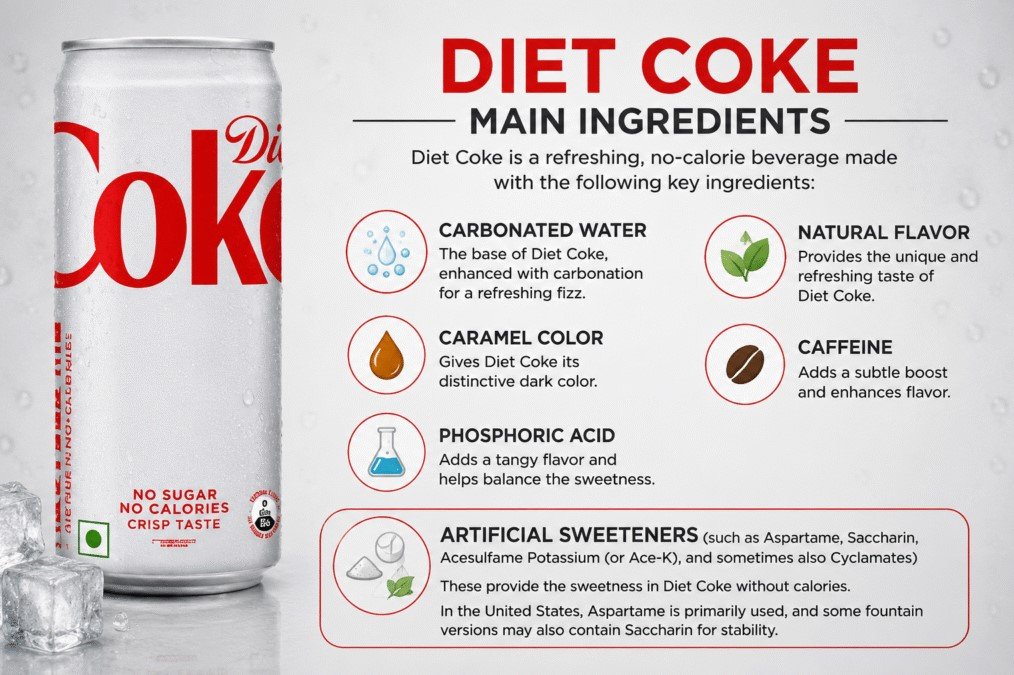
Here’s what actually goes into a can of Diet Coke sold in India, according to the official ingredient list:
Notice what’s missing: sugar. That’s the entire point of Diet Coke. Instead of sugar providing sweetness and calories, aspartame and acesulfame K do the job at a fraction of a calorie.
Beverage companies often blend aspartame with acesulfame potassium because the two sweeteners work better together. Aspartame gives a clean, sugar-like sweetness, while acesulfame K helps that sweetness last longer on the tongue. Used alone, both have slight aftertastes — combined, they mask each other’s weaknesses.

This is the question most people search for, and it deserves a clear, honest answer.
Aspartame is one of the most extensively studied food additives in the world. Regulatory bodies across the globe — including the Food Safety and Standards Authority of India (FSSAI), the US FDA, and the European Food Safety Authority — have approved it as safe for general consumption at recommended intake levels.
In 2023, the World Health Organization’s cancer research arm classified aspartame as “possibly carcinogenic to humans” — but in the same breath, the WHO’s food additive experts reaffirmed that the existing safe daily intake limit remains unchanged. To put that in perspective, an adult would need to drink roughly 12-15 cans of Diet Coke every single day, every day, to cross that safety threshold.
People with a rare genetic condition called phenylketonuria (PKU) cannot properly process phenylalanine, an amino acid found in aspartame. That’s why Diet Coke cans carry a specific warning for PKU patients. If you don’t have this condition, this warning doesn’t apply to you.
Bottom line: For the average healthy adult, occasional to moderate Diet Coke consumption is not considered a serious health risk by current food safety science. Like most things, moderation matters more than the ingredient itself.
| Nutrient | Amount (per 330 ml can) |
| Calories | Less than 1 kcal |
| Sugar | 0 g |
| Carbohydrates | 0 g |
| Fat | 0 g |
| Protein | 0 g |
| Sodium | Approx. 20-40 mg |
| Caffeine | Approx. 33-46 mg |
Compare this to a regular 330 ml Coke, which contains close to 140 calories and 35 grams of sugar — roughly seven teaspoons. That gap is exactly why Diet Coke appeals to people watching their sugar or calorie intake.
Many people confuse Diet Coke with Coke Zero, assuming they’re the same drink with different labels. They’re not.
| Feature | Diet Coke | Coke Zero | Regular Coke |
| Calories | Less than 1 | Less than 1 | ~140 per can |
| Sugar | 0 g | 0 g | ~35 g per can |
| Taste profile | Sharper, lighter cola flavour | Closer to original Coke taste | Original sweet cola |
| Sweetener | Aspartame + Acesulfame K | Aspartame + Acesulfame K | Sugar |
| Caffeine | Slightly higher | Slightly lower | Standard |
| Recipe origin | Original 1982 diet formula | Newer formula designed to mimic full-sugar Coke | Original 1886 formula |
The biggest difference isn’t nutrition — both diet versions are essentially calorie-free. It’s taste. Diet Coke has a distinct, slightly sharper flavour that long-time fans specifically prefer, while Coke Zero was engineered to taste almost identical to regular Coca-Cola.

None of these drawbacks are unique to Diet Coke — they apply broadly to most carbonated, caffeinated soft drinks, diet or otherwise.


Diet Coke pricing varies by city and retailer, but here’s a general range you’ll find across Indian markets:
Availability tends to concentrate in metro and tier-1 cities — Mumbai, Delhi, Bengaluru, Hyderabad, Chennai, Pune, and Kolkata — where it’s stocked in supermarkets, premium kirana stores, and online grocery platforms. In smaller towns, stock can be inconsistent, and shoppers often turn to quick-commerce apps for reliable delivery.
Global supply factors, including occasional aluminium can shortages, have periodically affected the consistency of imported and packaged beverage stock in India, so availability isn’t always guaranteed year-round in every location.

While Diet Coke is generally considered safe for healthy adults in moderation, certain groups should be more cautious:
If you fall into any of these categories, it’s worth speaking to a doctor or nutritionist before making Diet Coke a regular habit.

If you enjoy the fizz but want to explore other options, consider:
These options won’t taste like cola, but they solve the same underlying craving — something refreshing, cold, and not loaded with sugar.
In moderate amounts, Diet Coke is not considered harmful for most healthy adults. Problems tend to arise with excessive daily consumption, not occasional drinking.
No, Diet Coke contains virtually zero calories. However, some research suggests artificial sweeteners may influence appetite or cravings in certain people, which could indirectly affect eating habits.
Diet Coke contains no sugar, making it generally safer than regular Coke for people managing blood sugar. Still, diabetics should consult their doctor, since individual responses to artificial sweeteners can vary.
Both are sugar-free and calorie-free, but they use different original recipes. Diet Coke has a lighter, sharper flavour, while Coke Zero was designed to closely match the taste of regular Coca-Cola.
Yes, a standard can contains roughly 33-46 mg of caffeine, slightly less than a regular cup of instant coffee.
Aspartame has been classified as “possibly carcinogenic” by one WHO research body, but food safety regulators worldwide maintain that it’s safe within established daily intake limits, which are far higher than typical consumption.
The product label itself advises against consumption during pregnancy and breastfeeding. It’s best to avoid it and consult a doctor for safer alternatives.
Diet Coke uses artificial sweeteners instead of sugar, which naturally changes the mouthfeel and aftertaste compared to the sugar-based original recipe.
It’s widely available in metro and tier-1 cities through supermarkets and quick-commerce apps, but stock can be limited or inconsistent in smaller towns.
There’s no official strict limit, but most health experts suggest treating it as an occasional drink rather than a daily replacement for water, ideally limiting intake to one or two cans a day.
Diet Coke fills a specific gap — it gives cola lovers a way to enjoy that familiar fizzy taste without the sugar and calorie load of regular soft drinks. The ingredients, while artificial, have been studied extensively and are approved as safe by major food regulators, including in India.
That said, “safe” doesn’t mean “ideal for daily use.” Like most processed drinks, Diet Coke works best as an occasional treat rather than a substitute for water. If you’re mindful of your sugar intake, want a caffeine boost, and enjoy the taste, an occasional can fits comfortably into most healthy routines. But for daily hydration and long-term health, water, buttermilk, and naturally flavoured drinks remain the smarter everyday choice.
Ultimately, the decision comes down to your personal health goals, any existing medical conditions, and how the drink fits into your overall diet — not fear, just informed moderation.


